The Agentic Enterprise: Strategic MCP Adoption for Business Leaders
With 35% of leading organizations already adopting Agentic AI, understanding MCP is critical for business leaders. Use our framework for conducting enterprise workflow reviews, identifying bottlenecks, and implementing AI-powered solutions that connect directly to your business systems—from assisted workflows with Claude Desktop to fully autonomous agents with n8n.
The business landscape is shifting faster than most leaders realize. According to a joint study by Boston Consulting Group and MIT Sloan, 35% of leading organizations have already deployed Agentic AI, with another 44% planning to follow suit. The window for strategic advantage is rapidly closing.
The question isn't whether your organization will adopt Agentic AI—it's how quickly and strategically you can do it. And at the heart of this transformation is the Model Context Protocol, or MCP.
MCP is the infrastructure enabling the Agentic Enterprise. While most executives focus on hiring AI talent or piloting chatbots, they're missing the fundamental shift: AI agents that can actually connect to and act across your existing business systems. This article provides you with a practical, proven framework to evaluate your organization's readiness and implement Agentic AI strategically—from conducting enterprise workflow reviews to choosing between assisted and autonomous approaches.
What is the Agentic Enterprise?
It seems like another "buzz-phrase" - but it's one that is starting to gain more and more traction towards the backend of this year. One of the first companies to mention this were Salesforce, they define the Agentic Enterprise as:
An agentic enterprise is a business where people and intelligent AI agents work together. These AI agents can reason, adapt, and act on their own to complete tasks. This collaborative model frees up human employees to focus on more creative and strategic work.
Deloitte also released a publication in September this year titled Agentic Enterprise 2028, one key takeaway from the publication.
Agentic AI isn’t just smarter automation — it provides a strategic blueprint for enterprises to achieve cost efficiency, drive revenue growth, and unlock the full potential of their talent.
What is Model Context Protocol?
MCP is like a universal adapter that allows AI assistants to securely connect to and interact with your existing business systems - whether that's your CRM, databases, file storage, or collaboration tools. Instead of building custom integrations for each AI tool and each business system separately, MCP provides a standardized way to connect them all.
Think of it as similar to how USB-C standardized device charging - instead of needing different cables for every device, you have one standard that works everywhere.
"Tools" are also a fundamental concept to understand, especially with MCP. Think of tools like buttons on a remote control. Each button does one specific thing:
- Change the channel
- Adjust volume
- Turn on/off
In MCP, tools are specific actions that an AI Agent can perform in your business systems once it is connected. This is where the true power exists when AI can interact with your business systems.
The Industry Momentum
The adoption signal is unmistakable. As Sam Altman put it: "People love MCP, and we are excited to add support across our products". The fact that OpenAI is openly adopting the brainchild of one of its biggest rivals (Anthropic) speaks volumes.
I would be very surprised if every major software vendor doesn't have support for MCP at some point in 2026. Here are some of the biggest companies to have already released their own MCP servers:
- SAP - September 2025
- Figma - June 2025
- Salesforce - June 2025
- Atlassian - May 2025
- Shopify - March 2025
- Stripe - February 2025
How MCP Connects Everything
The Strategic Imperative
Now that you understand what MCP is, here's why it matters urgently for your business. The BCG and MIT Sloan report titled "The Emerging Agentic Enterprise: How Leaders Must Navigate a New Age of AI" reveals something critical:
While 35% of organizations have already adopted Agentic AI (with another 44% planning deployment), businesses are implementing it faster than leaders can redesign processes.
Leaders see the value clearly—not only for cost efficiency but for expanding revenue, accelerating innovation, compressing learning curves, and restructuring organizations. But there's a gap the report doesn't address: the infrastructure challenge.
Agentic AI for isolated, custom-built tasks is one thing. But the true "Agentic Enterprise" where AI improves efficiency across entire workforces—requires agents that can access the same tools as your workforce. This is where MCP now becomes mission-critical.
"The rise of agentic AI will reshape not just isolated tasks but entire workflows. For CEOs, the central question is no longer 'Where can I automate a step?' but rather 'How will process design itself fundamentally change?' Agentic systems don't simply make existing steps proceed faster; they invite leaders to rethink the design of whole workflows, blending human judgment and machine autonomy in ways that legacy processes were never built to accommodate."
The question now becomes: how do you prepare your organization for this transformation?
The Enterprise Workflow Review Framework
Here's your answer: a practical, four-step framework to evaluate your organization's readiness for Agentic AI adoption. This isn't theoretical—it's the systematic approach forward-thinking leaders are using right now to identify where MCP-enabled agents can deliver the highest ROI.
Having a solid framework to evaluate your existing workflows is essential as you prepare for Agentic AI adoption. You need to run this across your entire business, every department—identifying the existing tool stack across your workflows, seeing which ones are easy to put into the hands of your agents, as well as identifying the current bottlenecks and frictions between humans and tooling.
Steps 1 through 3 are all about evaluating your current processes. The best format to start documenting this is within some form of enterprise knowledge base—we recommend using a tool like Notion or Confluence.
Both of these tools have MCP support, which means AI can directly access and act on your documentation. This is far more powerful than storing workflow information in static formats like PowerPoint.
Workflows
Start by mapping out the different workflows and steps within them, ideally for each department. This is a framework, so you can start with a single department or workflow and then scale out depending on the interest or critical areas of your business.
It's important to try to keep this lightweight/light touch to start with, detailing things like:
- Steps & sub-steps within a workflow - not too granular
- Current role responsible
- A simple efficiency rating (low/medium/high)
For each individual step within the process, a brief overview or detail is also great. Keeping it in a simple & readable structure like this means that in the future, you can use this knowledge to allow AI to help you re-design your processes (using MCP).
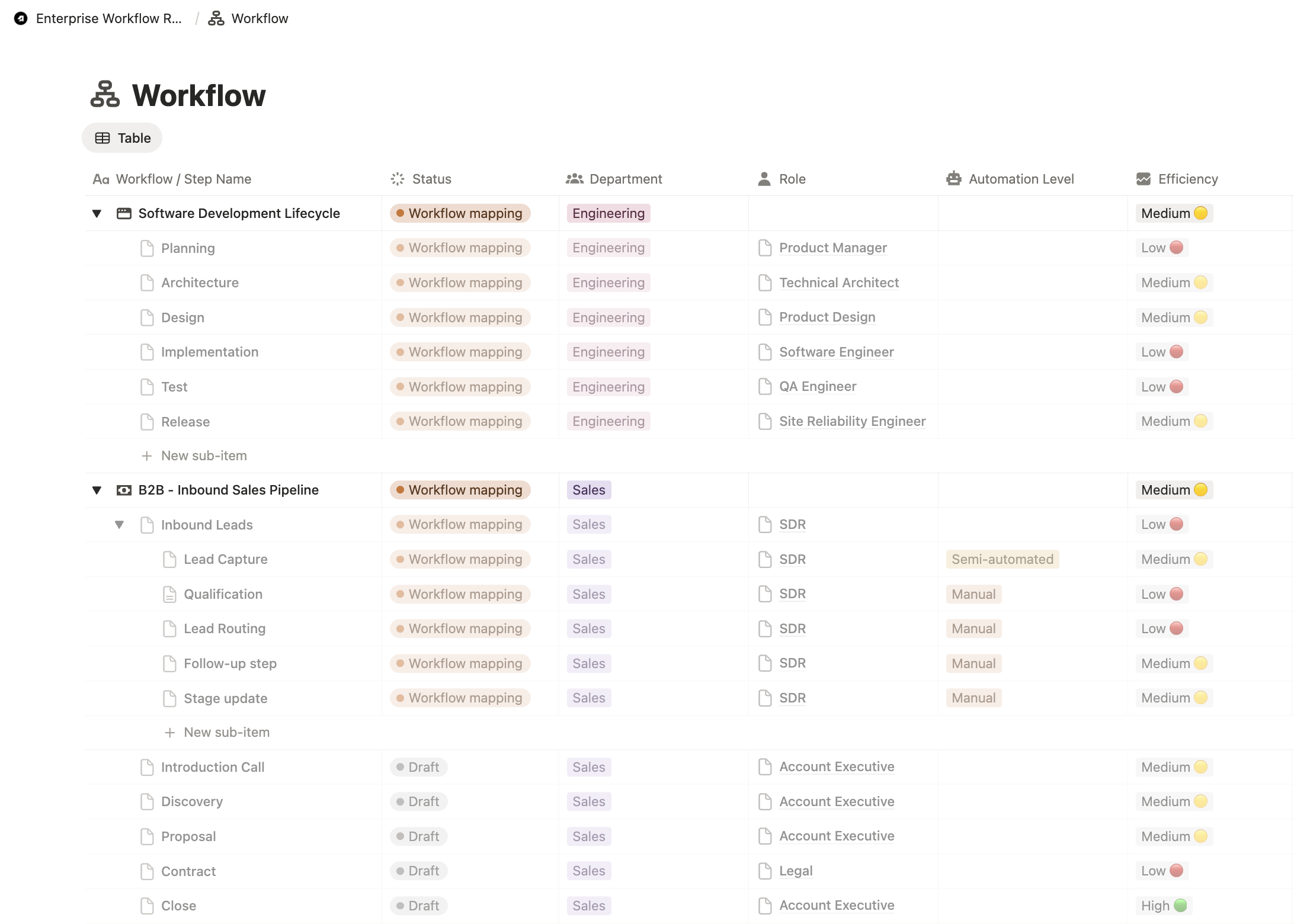 Business Efficiency Review - Workflow Overview
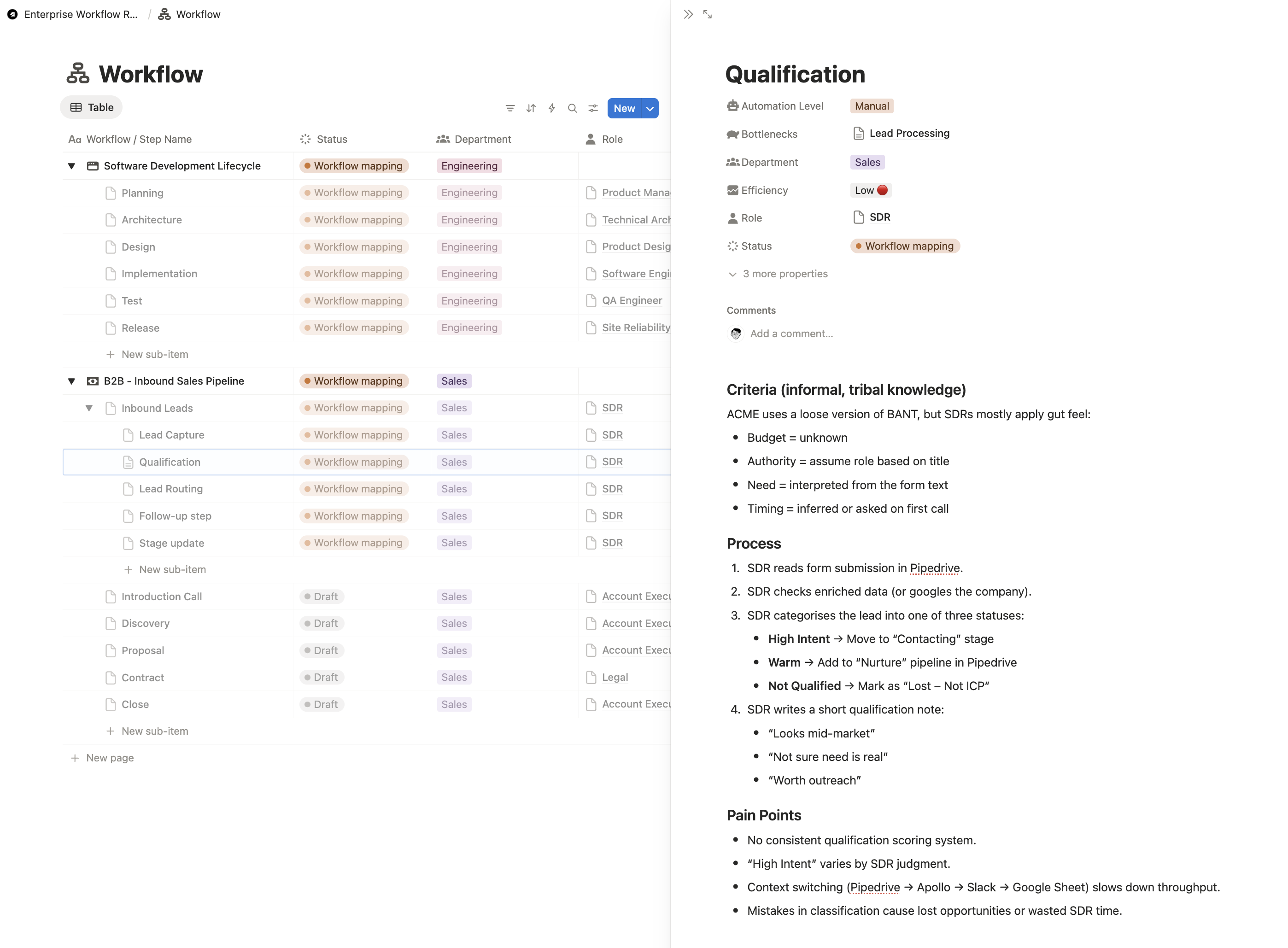 Business Efficiency Review - Workflow Step
Tools
The next step, is to run a full audit of the tools being used within each of these steps. The main objective is to understand which tools are the most used, and which ones can be connected up to your future Agentic Systems with Official MCP support; obviously if there are tools playing a huge part in your processes which are quite legacy or not really compatible with AI, for example un-structured data in PowerPoint which is difficult to feed into an LLM versus hard documentation in a Knowledge Base then you likely have some work to do and some decisions to make as to how you make the steps of your process more compatible with AI.
Again, Notion is a great tool because of the easy-to-use Database concept that allows you to link relationships. In the worked example, you can start to now see where the landscape of tools sits within your processes and workflows which better enables you for the next steps.
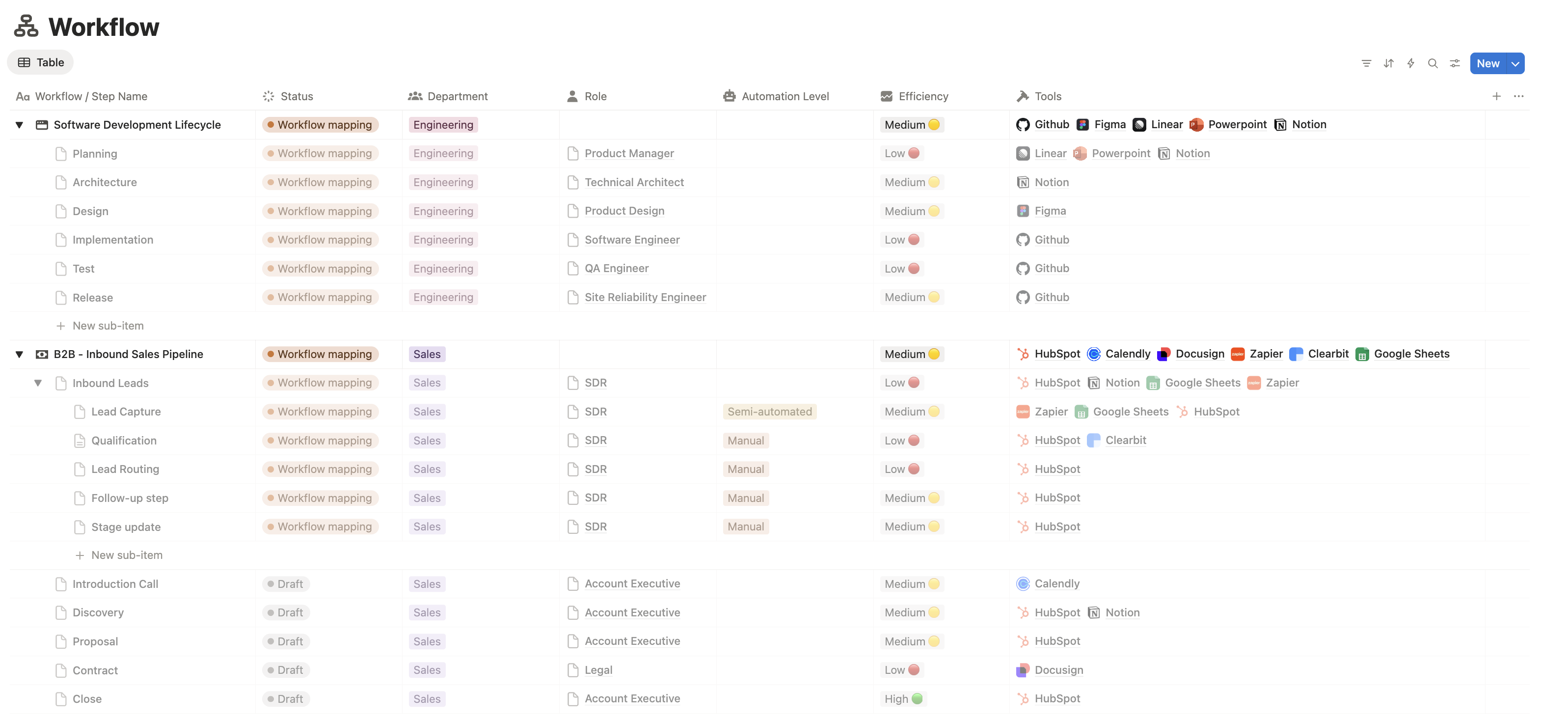 AGNTC Business Efficiency Review - Tools
Bottlenecks
With your processes identified, and tooling identified, you can now start to holistically isolate and list bottlenecks within your current processes. This is where you will identify all of the critical bottlenecks within the process steps. Armed with the knowledge of tooling, and if those can be connected via MCP to an Agent, you can start to prioritize the highest impacting processes that need re-thinking to optimize efficiency.
It's important to use the steps above, focus first on the least efficient processes—as realistically these are the highest ROI.
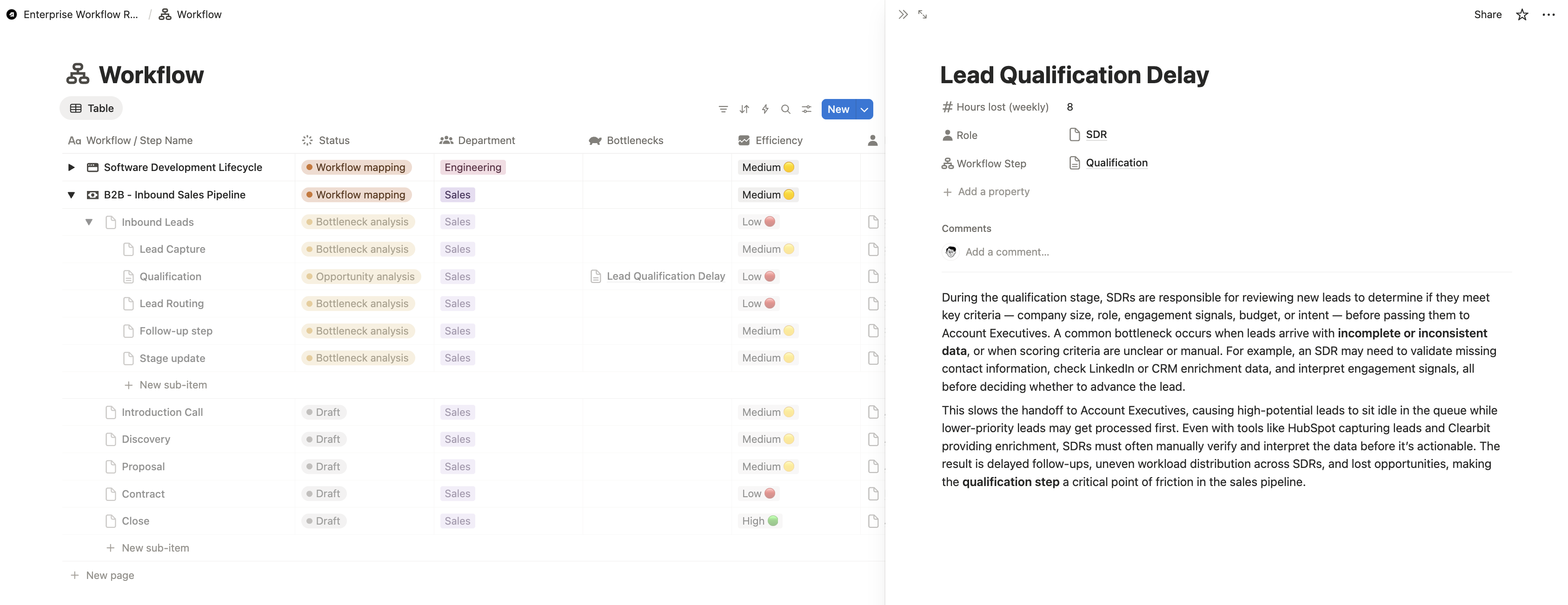 Business Efficiency Review - Bottlenecks
Opportunities
This can now be turned into an opportunity, with the following mission statement (as an example):
By implementing Automatic Lead Prioritization through an Agentic AI, the business can enrich, score, and rank leads automatically before they reach the SDRs. The system can surface high-value opportunities first, validate contact information, and provide contextual summaries for each lead. This allows SDRs to focus entirely on engaging the most promising prospects, reduces delays in follow-up, and increases conversion rates without hiring additional headcount. In essence, the opportunity is to turn a labor-intensive bottleneck into a streamlined, intelligence-driven process that maximizes pipeline efficiency.
The challenge now becomes taking this opportunity and optimizing the process. There are two options for building a solution:
- Allowing your existing employees to have access to deeper intelligence by allowing their day-to-day AI assistance to integrate with the systems
- Going one step further, and building an Agent equivalent of the role that can execute an entire step in the process and automate it
Each option has a different level of investment and requires a completely different level of skills/knowledge. Option 1 is lighter touch and easier to get going, but Option 2 is where the highest ROI lies—if you get it right.
From Framework to Action
Theory meets practice. Let's see this framework applied to a real scenario: a sales team using Salesforce. This example demonstrates how MCP enables both assisted (human-in-loop) and agentic (fully automated) approaches to the same workflow.
The Scenario
Say your sales leadership team needs daily updates on deals close to closing:
Each day can you give me an update on deals that are close to closing?
Typically, a human would log in to Salesforce to do this, compile the data and send it in a message. With Agentic AI and MCP, that entire process could be automated. This example demonstrates the principle of exposing multiple MCP servers to the same agent—you can layer up integrations across your business systems and multiply the impact.
There are two implementation approaches, each with different trade-offs:
Approach 1: Assisted Intelligence
Anthropic is the undisputed MCP leader and has offered first-class support for nearly a year. Claude Desktop is also a premier enterprise solution.
This month Cognizant adopted Claude for 350,000 of its employees—primarily for Claude Code for Agentic-driven Development but also internally for other key corporate functions.
Cognizant plans to align its software engineering and platform offerings with Anthropic capabilities – including Claude for Enterprise, Claude Code, the Model Context Protocol (MCP), and the Agent SDK – so clients can integrate AI with existing data and applications, orchestrate multi-step work with human oversight, and more effectively manage performance, risk and spend.
Enterprises adopting AI at scale need solutions that integrate with existing systems and deliver tangible outcomes. Cognizant's use of Claude aims to help clients move faster from pilot to production and scale AI capabilities across the enterprise. Cognizant will also provide Claude internally to associates across key corporate functions, engineering and delivery teams to enhance productivity and advance AI maturity.
Claude Desktop allows you to start to move towards more intelligent workflows, connecting your business systems to AI but only really as an assistant to your existing employees rather than moving towards being fully Agentic.
With Claude Desktop being a MCP Client with a seamless user experience on the desktop, it allows your employees to potentially navigate and interact from a single place with natural language. Imagine how your staff use ChatGPT today, but empowered with connectivity to your business systems.
To differentiate between Assistance and Agentic - taking the Salesforce example with Claude Desktop, rather than:
- Opening Salesforce
- Logging in
- Navigating to information
- Extracting the information
- Sending the information
A user of Claude Desktop, connected to Salesforce and Teams via MCP, could ask:
Find the next 5 deals to close and send them to the sales teams channel
Approach 2: Autonomous Agents
Going to the next level, you can use a tool like n8n and connect it directly to MCP servers. This creates a purely agentic solution—no human-in-the-loop required. This is more involved than Approach 1, but the ROI difference is substantial when the process is completely autonomous.
This approach requires a level of expertise and investment into building and testing these workflows, while Approach 1 is more "plug and play" with minimal friction. For most organizations, Approach 1 is the better starting point, with a phased evolution to fully autonomous adoption.
Choosing Your Path
Which approach is right for your organization? Here's a practical decision framework:
Choose Claude Desktop (Approach 1) when:
- You're starting your Agentic AI journey
- You want quick wins with existing employees
- Human oversight is essential for your workflows
- You have limited technical resources for custom development
- You need to prove ROI before larger investments
Choose n8n (Approach 2) when:
- You're ready for autonomous, lights-out processes
- You have technical implementation capacity
- The workflow is high-volume and highly repeatable
- Maximum ROI is the priority and worth the investment
- You've already validated the process with Approach 1
For most organizations: Start with Claude Desktop for immediate impact and learning. Identify your highest-value, most repeatable processes. Once proven, evolve those specific workflows to fully autonomous execution with n8n. This phased approach minimizes risk while maximizing learning and ROI.
Security & Governance
Implementation without security is reckless. Before deploying MCP-enabled agents across your organization, enterprise leaders must address several critical security considerations—and understand the attack vectors unique to MCP deployments.
Use Official MCP Servers Only
Critical Rule #1: Only connect to Official MCP servers from trusted, verified vendors. This cannot be overstated.
The MCP ecosystem allows anyone to create and distribute MCP servers. While this openness drives innovation, it also creates risk. Unofficial or community-built MCP servers may contain malicious code, backdoors, or security vulnerabilities that could compromise your entire infrastructure.
When auditing tools in your Enterprise Workflow Review (Step 2), prioritize vendors who have released Official MCP servers:
- SAP, Figma, Salesforce, Atlassian, Shopify, Stripe (as listed earlier)
- Verify the source and authenticity of any MCP server before deployment
- Establish an approval process: only your security team can whitelist new MCP servers
Common MCP Attack Vectors
Understanding how MCP can be exploited is essential for building proper defenses:
Tool Poisoning: This is the most significant threat unique to MCP. An attacker compromises an MCP server or creates a malicious server that masquerades as legitimate. When an agent uses the poisoned tool, it executes malicious actions—data exfiltration, privilege escalation, or system manipulation—while appearing to perform normal business operations.
Mitigation: Only use Official MCP servers, implement strict allowlisting, and monitor tool execution logs for anomalous patterns.
Prompt Injection via MCP: Attackers craft malicious data that, when retrieved by an MCP server, manipulates the AI agent's behavior. For example, a compromised CRM record could contain instructions that cause the agent to leak sensitive data or perform unauthorized actions.
Mitigation: Implement input validation and sanitization at the MCP server level. Never trust data retrieved from external systems without validation.
Credential Theft: MCP servers often require API keys or credentials to access business systems. If these are improperly stored or transmitted, they become targets for theft.
Mitigation: Use secrets management systems (e.g., HashiCorp Vault, AWS Secrets Manager). Never hard-code credentials. Implement credential rotation policies.
Lateral Movement: Once an agent has access to one system via MCP, a compromised agent or MCP server could attempt to access other connected systems, moving laterally across your infrastructure.
Mitigation: Implement least-privilege access. Each agent should only have access to the minimum MCP servers and tools required for its specific function.
The MCP Security Model
MCP is designed with security as a foundation. The protocol operates on an explicit permission architecture—agents can only access systems and perform actions they've been explicitly granted permission to use. Unlike traditional API integrations that often require broad access credentials, MCP implements fine-grained control at the tool level.
For many organizations, MCP's local-first execution model provides significant security advantages. When running Claude Desktop, for example, MCP connections execute on the user's local machine rather than routing through external servers. This means sensitive business data never leaves your network perimeter.
Key Governance Considerations
Authentication & Authorization: Implement role-based access control (RBAC) for MCP server access. Not every employee needs access to every system. Define clear policies for which roles can access which MCP servers and tools.
Audit Trails: Ensure your MCP implementation logs all agent actions. Who requested what data? What systems were accessed? What modifications were made? These logs are essential for both security monitoring and compliance requirements.
Data Residency: Understand where data flows. With local execution (Claude Desktop), data stays within your infrastructure. With cloud-based solutions, verify data handling practices meet your compliance requirements (SOC 2, GDPR, HIPAA, etc.).
MCP Server Allowlisting: Maintain a centrally managed allowlist of approved MCP servers. Implement technical controls that prevent agents from connecting to any MCP server not on the allowlist.
Questions for Your Security Team
Before rolling out MCP broadly, ensure your security team can answer:
- What is our process for vetting and approving new MCP servers?
- How will we detect and respond to tool poisoning attempts?
- What audit logging will we implement to track agent actions?
- How does this integrate with our existing identity management and secrets management?
- What's our incident response plan if an agent performs an unauthorized action?
- How will we monitor for lateral movement across MCP-connected systems?
Security shouldn't slow adoption—it should enable confident, responsible scaling.
Taking Action
The Agentic Enterprise is emerging faster than most leaders realize. While 35% of organizations have already adopted Agentic AI, the critical differentiator isn't adoption itself—it's strategic implementation. MCP is the connective tissue enabling this transformation, and leaders who understand it now have a significant advantage.
The four-step Enterprise Workflow Review framework gives you a systematic approach to identify where AI agents can deliver the highest ROI:
- Workflow Mapping - Document your processes
- Tool Audit - Identify MCP-compatible systems
- Bottleneck Analysis - Find the highest-impact opportunities
- Opportunity Prioritization - Build your roadmap
Start small, learn fast, and scale what works. Begin with Claude Desktop for assisted intelligence, then evolve your highest-value workflows to autonomous execution with tools like n8n.
Your Next Steps
This week:
- Conduct a pilot workflow review for one critical process
- Audit which of your current tools have MCP support
- Identify your first implementation opportunity
This month:
- Implement Claude Desktop for a single team or workflow
- Document the impact and lessons learned
- Build your roadmap for broader adoption
This quarter:
- Scale successful assisted workflows across teams
- Identify candidates for autonomous execution
- Engage your security team on governance frameworks
The question isn't whether Agentic AI will transform your business—it's whether you'll lead the transformation or react to it. The infrastructure is here. The framework is clear. The time to act is now.